Two listings cross a buyer's desk on the same afternoon. Both sit on Geneva Lake. Both ask close to $2.8 million, which happens to be roughly the median lakefront price on the lake as of this spring. Both come with a dock, a boat slip, and a broker's note that reads "excellent value per foot."
They are not the same property. One sits on a quiet, tree-shaded stretch of the south shore with 200 feet of frontage and a century-old carriage house. The other sits on 90 feet in the busiest quarter mile of the lake, a five-minute walk from downtown restaurants, with foot traffic passing the living room window most summer evenings. A buyer who compares them using price per foot alone will conclude the second property is the better deal. That conclusion is often wrong, and the reason it's wrong tells you almost everything you need to know before you write an offer on this lake.
The Metric Everyone Quotes, and Why It Breaks
Price per foot works fine when the thing being measured is uniform: carpet, drywall, a subdivision lot on flat ground. Geneva Lake's 21 miles of shoreline are not uniform. Depth varies. Sun exposure varies. Some frontage sits on a shallow, weedy cove that's unusable for a real boat six months a year. Some sits on deep, west-facing open water with a sunset view that never changes owners without a fight.
That difference shows up in the spread of the market itself. As of this spring, lakefront sales on Geneva Lake ranged from around $1.2 million for a smaller, older cottage up to more than $15 million for a premier historic estate, a gap of more than tenfold on the same finite shoreline. Blend that entire range into one price-per-foot average and you get a number that describes no actual property on the lake. It's an average of a shallow cove and a deep-water point that happen to share a shoreline, not a valuation either one can stand on alone.
The lake's own scarcity makes this worse, not better. There are no new waterfront lots being created, and as of this spring lakefront inventory was running about 22 percent below 2020 levels. When supply is this tight, buyers under pressure to move quickly lean harder on shorthand numbers precisely when they should be leaning on local judgment instead.
What Each Shoreline Segment Actually Buys
The lake breaks into four shoreline segments, each with a different character and a different reason to pay what people pay there.
| Segment | Character | Price position | What it actually buys |
|---|---|---|---|
| East shore, City of Lake Geneva | Closest to downtown, walkable to restaurants and the Riviera pier | Most actively traded segment on the lake | A short walk to town, along with the most Shore Path foot traffic passing your property all summer |
| South shore, Town of Linn | Home to the lake's most prestigious historic estates | Commands the highest premiums | Larger, older parcels and the most privacy from the road, often paired with the largest restoration or maintenance budget |
| West shore, Village of Fontana | Widely considered the most private stretch of the lake | A step below the south shore on price | Distance from downtown Lake Geneva, traded for proximity to Fontana's own beach, Abbey Harbor Marina, and its restaurant strip |
| North shore, Village of Williams Bay | Considered the most affordable entry point to lakefront ownership | Lower average price per foot | The same finite 21 miles of shoreline access, at a lower basis, with a short walk into Williams Bay's own business district |
None of these are better or worse in the abstract. They're different products wearing the same word, "lakefront." A buyer who wants walkability accepts the east shore's crowds. A buyer chasing quiet accepts Fontana's distance from downtown. The mistake is comparing a Linn Township estate to a Williams Bay bungalow using a single blended number and being surprised when the negotiation doesn't match the spreadsheet.
The Easement Running Through Every Yard
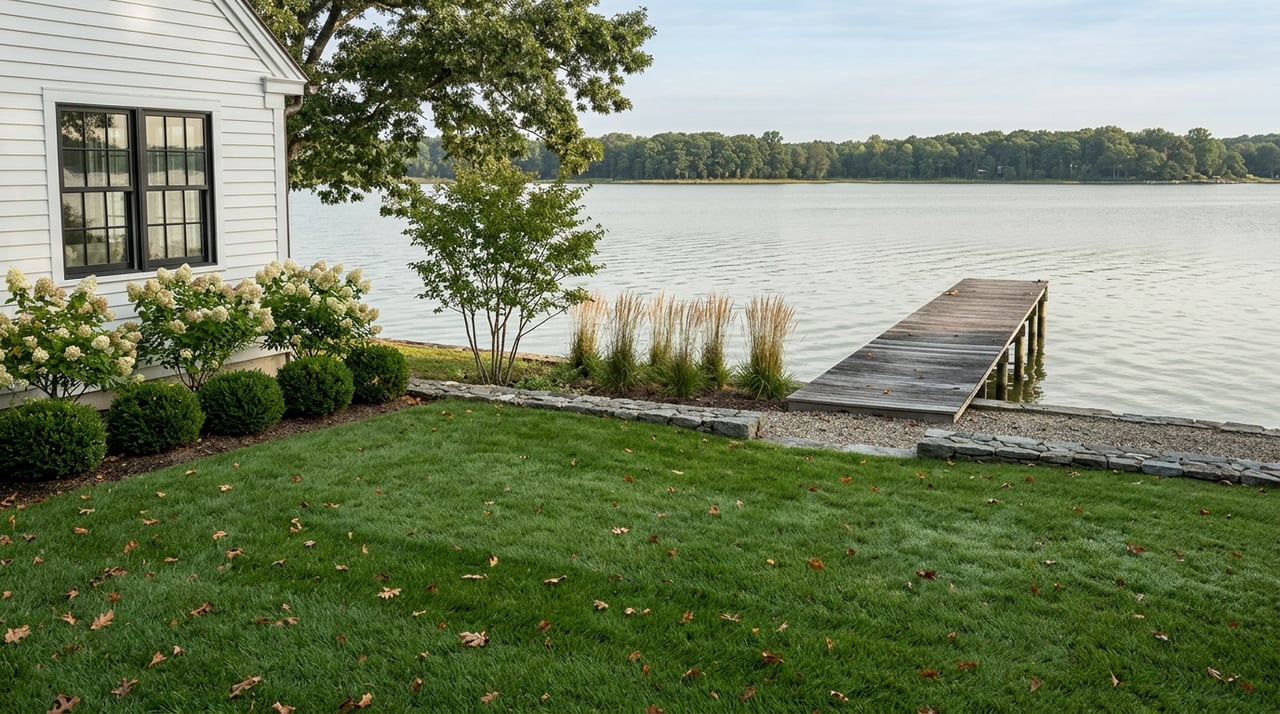
Here is the detail that catches out-of-state buyers more than any pricing quirk: almost every parcel of Geneva Lake frontage carries a public walking easement between the house and the water. It's called the Shore Path, and it isn't a modern trail carved through a park. Settlers decreed generations ago that the strip of land nearest the shoreline "be preserved as public domain," and that decree has held. Today the path runs roughly 21 miles around the entire lake, through the yards of estates built by some of Chicago's oldest industrial families, and property owners are responsible for maintaining their own segment, which is why the surface changes constantly from lawn to brick to gravel to wood plank as you walk it.
Public access points exist in the city of Lake Geneva and in the villages of Williams Bay and Fontana, along with public boat launches on the south shore at Linn Pier Road and Hillside Road. Walkers use it during daylight hours, keep to the path, and are asked to stay off private lawns, piers, and boathouses. For a homeowner, this means a stranger with a dog and a water bottle may legally pass within a few feet of your porch on a Tuesday morning in July, every year, forever. Most buyers hear "lakefront" and picture total privacy. On this lake, "private" almost always means private from the water side, not the land side.
The Pier Permit Question Nobody Asks Until Closing
The second friction point is less scenic and more consequential to a closing timeline: the pier itself. Piers on Geneva Lake operate under permits issued by the Wisconsin Department of Natural Resources, and those permits are tied to the property, not the owner. In most sales the existing permit transfers with the deed, but a buyer still needs to confirm the permit is current and actually covers the use they're planning, whether that's a single slip, a boat lift, or a specific pier length. A permit written for one slip doesn't become three slips just because the seller says it's fine.
Any new pier, or any expansion of an existing one, restarts the clock. The DNR opens a public comment period, typically 30 days, and any interested party can request a public hearing within 20 days of that. One filing from late 2025 for a Williams Bay property, for instance, sought approval for a 100-foot, three-slip pier requiring 14 new cribs, a routine-sounding upgrade that still had to clear the same public notice process as anyone else's. On a larger scale, a proposal to add 100 boat slips across ten piers at Geneva National on adjoining Lake Como drew enough resident opposition that the project went through a public hearing and a redesign, cutting pier spacing and switching to semi-transparent decking, before it moved forward. If a project that size needs that much process, a buyer assuming a quiet, no-questions-asked pier upgrade after closing is assuming wrong.
The Geneva Lake Association keeps a running public log of DNR pier notices for exactly this reason, and it's worth a look before any offer goes in, not after.
Three checks worth making before you write that offer:
- Ask which segment of shoreline the comps you're being shown were actually pulled from, not just the blended lake-wide average.
- Confirm the pier's DNR permit number, slip count, and length match what the listing describes, in writing.
- Check the Geneva Lake Association's notices for pending pier or dredging applications on neighboring properties that could affect your own water access.
A Couple of Questions Worth Answering Directly
Does the Shore Path mean anyone can walk through my yard whenever they want? No. Access is meant for daylight hours only, on foot, with leashed dogs, and without bicycles or motorized use. It's a walking easement, not an open invitation to linger on private lawn or use a private pier.
If I buy a lakefront home, does the existing pier permit just come with it? Generally yes, but "generally" is doing real work in that sentence. Confirm the permit is active and matches the pier as built. Any change beyond that, including a longer pier or an additional slip, requires a new DNR review before you can build it.
Price per foot will keep getting quoted on this lake because it's simple and it fits in a sentence. The four shoreline segments, the Shore Path running through the yard, and the pier permit sitting behind every "boat slip included" listing don't fit in a sentence, which is exactly why they're the parts worth getting right before you sign anything.
If you're comparing shoreline segments and want the version of this analysis specific to a property you're actually considering, Tricia Forbeck at HomesInLakeGeneva.com has spent 26 years walking this shoreline segment by segment. Request a private consultation with Tricia before you make an offer, not after.